100 years in the Philippines
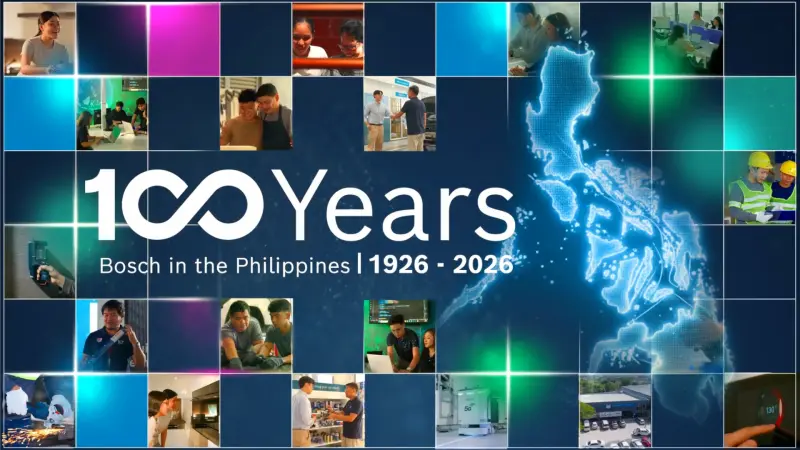
At 4:00am, hands are already at work - tightening bolts before the first jeepney departs, checking control panels before factory lines move, steadying drills beneath a rising skyline, preparing breakfast before the rest of the household wakes.
Long before most people begin their routines, the steady hands of the Filipino workforce are already at work. Commutes start when skies are still dark to avoid traffic congestions that pile up as early as 5:00am, factory shifts begin before sunrise to meet production targets, construction crews start early to work around the day’s heat, and homemakers prepare households before the rest of the city wakes. These early hours reflect the quiet sacrifices behind the country’s daily rhythm - work that rarely takes the spotlight but keeps the Philippines moving. For a century, Bosch and its associates stood beside the people that built the nation.
Keeping vehicles safe and moving
Traffic builds before sunrise, prompting many Filipinos to start their day early to stay ahead of the long hours on the road. Metro Manila is home to over 13 million people, and carries more than 31% of the country’s 13 million registered vehicles. A 10-kilometer trip takes nearly 32 minutes on average, and over the course of a year, Filipinos can spend the equivalent of five full days in traffic.

Vehicles in the Philippines remain on the road for an average of 15 years, significantly longer than the global average of around five.
Peewee strengthens a growing Bosch Car Service network that ensures workshops meet rigorous technical standards while operating sustainably. Bosch’s presence in automotive servicing in the Philippines dates back to the 1920s, when the first Bosch car maintenance workshops were established to support a growing vehicle market. Today, Bosch continues that legacy through its partnership with the Ayala Group, the country’s oldest conglomerate, and also one of the top publicly listed conglomerates in Southeast Asia. The combination of Bosch’s global automotive expertise with Ayala’s deep local reach, allows the expansion of after-sales services across the country - supporting both long-standing internal combustion engine (ICE) vehicles and the emerging generation of electric, and hybrid platforms.
Professional care for power tool users in construction sites
Construction rarely pauses in the Philippines and is anticipated to grow at 7% year-on-year from 2026 until 2031. In cities like Metro Manila, Cebu, and Davao, cranes trace the skyline as new commercial towers and mixed-use developments rise. Beyond major cities, roads stretch farther into growing provinces with warehouses multiplying to support expanding trade and residential communities taking shape to house a young, urbanizing population.


Infrastructure spending in the Philippines continues to represent roughly 5–6% of gross domestic product (GDP), and productivity on site directly affects project timelines and costs. Bosch’s 18V systems and professional-grade tools are engineered for continuous use under demanding tropical conditions. However, performance is affected by hands that operate them – this is where Golden and Myong come in.
As field trainers for Power Tools, they spend much of their time on construction sites working directly with contractors and tradesmen. They do not just introduce new tools - they educate tradesmen on proper handling, battery management, maintenance routines, and safety protocols to keep tools efficient and the users safe in their daily work.
Enabling service that never sleeps
Service in the Philippines runs around the clock. In Manila’s business districts, lights remain on long after sunset as teams support global business process outsourcing operations across time zones. The country’s Information Technology and Business Process Management (IT-BPM) sector contributes around 8–9% of national GDP, employing millions of Filipinos in customer support, IT services, and digital operations.

Krissy began her career as a frontline service agent. Today, she leads operations and digitalization efforts in the Philippines. Chrissy founded the Digitalization and Automation department, which is now the fastest-growing segment of SOPH and is projected to represent 50% of the SOPH’s business by 2027.
Since 2010, Bosch Service Solutions has grown into a strategic hub supporting global Bosch divisions across Asia, Europe, Oceania, and the United States.
Keeping lives and businesses safe
Urbanization in the Philippines continues to accelerate, with more than 48% of the population now living in cities and the urban population projected to exceed 60% by 2050. Commercial towers, transport terminals, hospitals, and mixed-use developments operate around the clock, increasing the demand for reliable fire protection systems.

Lito works directly with contractors, developers, and property managers - commissioning systems, calibrating detectors, conducting preventive maintenance, and ensuring compliance with both local regulations and international safety standards.
In a market building high-rise infrastructure and expanding beyond tier 1 cities, engineers like Lito ensure that safety systems evolve alongside the structures they protect - quietly safeguarding lives and businesses every day.
BSH
The Philippines is one of Southeast Asia’s most consumption-driven economies, with household spending accounting for nearly 70% of GDP. Urbanization is accelerating with condominium supply growing around 33% year-on-year as of 2025 in Metro Manila, while Cebu, Davao, and other regional growth centers saw an increase in premium developments.

Bosch built-in appliances are integrated into premium residential developments across key urban centers and emerging growth corridors beyond Metro Manila. The Philippines’ consumer market has reached approximately 1.2 billion Euros in 2024 and is forecasted to grow to 2 billion Euros by 2030 – reflecting rising demand for quality, efficiency, and design-led living. With electricity costs averaging around 0.20 Euros per kilowatt hour and households increasingly mindful of utility spending, energy-efficient systems are not only desirable but economically relevant.
Drawing from his experience as an architect by profession, Jayson approaches appliances as integral design elements. He works closely with developers and project teams to ensure that technical specifications align with spatial planning, ventilation, cabinetry integration, and overall architectural intent. In a housing market where layout efficiency and finish quality define property value, his dual perspective bridges engineering precision with architectural sensibility – ensuring technology enhances how Filipino homes are experienced every day.
The Philippines is one of Southeast Asia’s fastest-growing economies, with projected GDP growth of around 6%, a population of around 117 million, and a median age of 25. It is young, urbanizing, and driven by momentum.

However, growth statistics alone do not move a nation forward - hands do. As traffic builds before the sun rises tomorrow, those hands will be at work again. From its early beginnings in 1926, as an automotive workshop in Cebu, Bosch stands with Filipinos, as it had always done for 100 years in the Philippines.
Contact person for press inquiries:
Juan Diego Bautista
Corporate Communications
Robert Bosch, Inc.